Back
BackWhat's Happening
Mama’s Museum Madness Bracket Challenge
March 11, 2026
Give kids real tools and managed risk and set the stage for exploration and invention.
If imagination can be measured, it would be measured in 1,800 sticks of hot glue. After all, that’s how many hot glue sticks Maker Studio participants can use in a month.
And while hot glue might seem like a common art supply, in the Children’s Museum’s Maker Studio, hot glue has reached celebrity status.
It comes in a variety of sizes, colors, and even sparkles. It can be used for repairing, bonding, and decorating. It also, funny enough, comes in handy when you want to make a hat.
So when we decided to devote an entire camp to Hot Glue, the Maker Studio really heated up.
The origin story of Hot Glue Camp is simple: we listened to our Maker Studio kids.
One student, Ryan, loved exploring with hot glue so much that he sometimes would say “goodbye” to the hot glue guns at the end of the night. Logan was often challenged by and inspired to use the hot glue guns for large-scale projects — even looking to fix objects around the Museum.
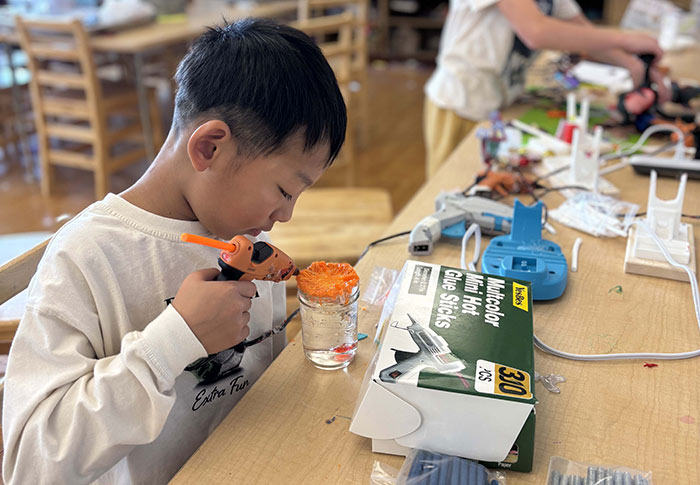
So it’s no surprise that Maker Studio kids went wild over a day devoted to exploring hot glue — especially since hot glue is not a material often accessible at home.
The Learning Framework of the Children’s Museum is centered around empowering children. The camp was created by following the interests of those who play in the Maker Studio.
Hot Glue Camp started with a thoughtfully designed environment. A buffet of materials, including bobbles, fake gems, sequins, molds, cardboard, bells, ribbon, fabric, beads, and pieces of broken toys, was presented throughout the room.
In addition, hot glue guns — large and small, corded and battery-powered — were ready to go.
But the real magic happened when the kids took charge.
By using these materials and tools, Maker Studio participants discovered that hot glue was a versatile material that is helpful for all sorts of construction. It sticks to and “plays nicely with” a variety of objects. We all have seen common applications of hot glue— such as adhering popsicle sticks to construction paper — but as campers learned by the end of the day, it can also act like a de facto 3D printer.
Despite all of this creativity, the fact is that hot glue can be hot — even with a lower temperature model. Maker Studio participants needed to assess the danger involved, manage their fears, and think critically about their work. This healthy risk-taking helps foster resilience and build self-confidence.
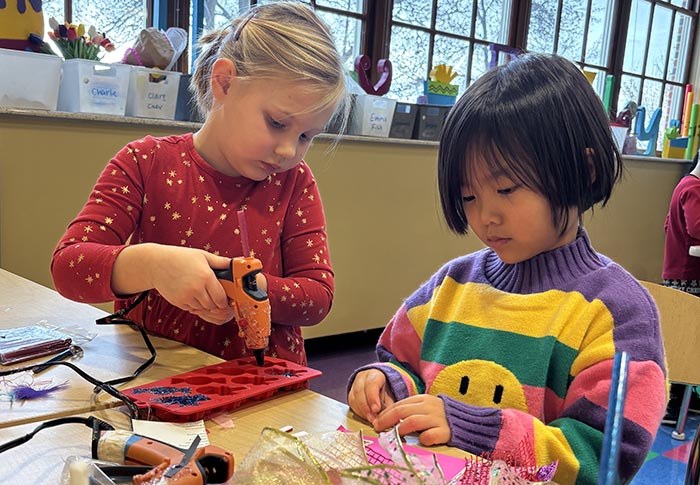
Throughout the camp, older children helped younger children use tools safely. Those with experience modeled responsibility, building an entire community around shared risk and shared excitement.
By exploring these materials, kids learned what it feels like to be trusted. They learned to problem-solve, to create items that require time, skill, and sometimes risk, asking for help when needed.
Ryan spent the day building a suit of armor for a stuffed dragon. He even created a helmet adorned with pom poms and bells.
Another student, Maggie, had experienced being hurt by the glue so she came up with workarounds, asking for help when needed, to pursue the results she was looking for.
And with the scraps and leftovers, teacher Blanche created a hot glue hat — a wearable sculpture fueled by creativity and delight.
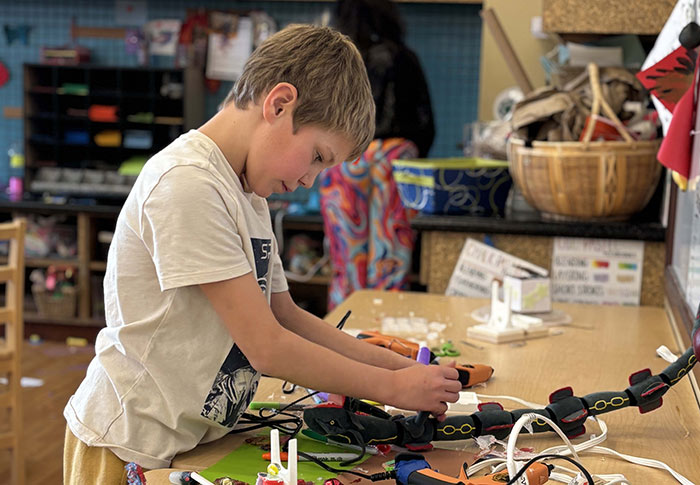
In the Maker Studio, the stakes of play are raised in a supportive, child-led, and safe way. Hot glue serves as a portal, and imagination is as big as our skies (or 1,800 glue sticks).
So what will the focus of our next all-day camp be? It’s hard to know — we will have to ask the kids.
Looking to turn up the heat on your child’s imagination?