Our learning philosophy centers on Empowering Children.
We place their voices, capabilities, and sense of identity at the heart of everything we do.
Whether it’s our exhibit spaces or the experiences in our camps and classes, our Learning Framework guides all of our work.
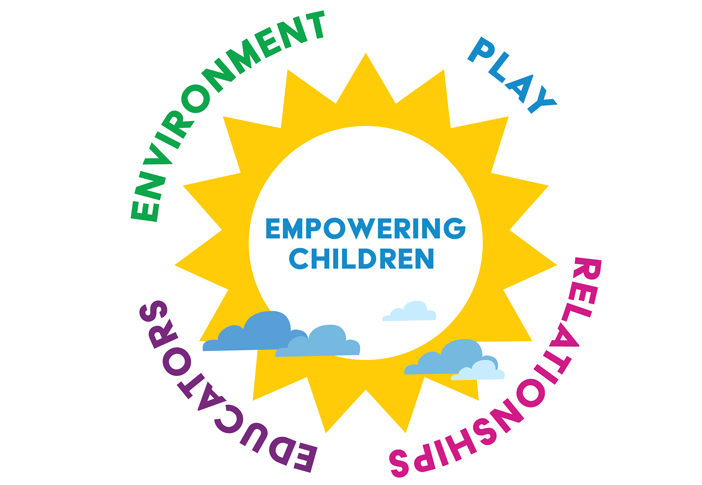 Using 4 components inspired by the Reggio Emilia educational philosophy — Environment, Play, Relationships, and Educators — we honor and uplift each child’s unique perspective and foster a space where children feel capable, valued, and eager to explore the world around them.
Our work (play) is Reggio-inspired
Our Environment is set up as an open invitation, accessible and inclusive, filled with loose parts and open-ended materials that spark curiosity, imagination, and self-directed discovery.
Through Play, children engage in child-led, inquiry-driven experiences that facilitate creativity and exploration, empowering them to take charge of their learning.
Relationships are nurtured by creating the space and time where children can express themselves, collaborate with peers, and engage across generations, fostering a sense of belonging and connection within their broader community.
Educators are co-learners, working alongside children to explore and discover. This approach nurtures lifelong learners who are confident, competent, capable, and curious.
Using these components, children are supported, empowered, and nurtured with a spark for discovery and lifelong learning.
Empowering Children
We honor children and place their voices, capabilities, and sense of identity at the heart of everything we do. We do this by:
 Uplifting Children’s Voices: Children provide valuable ideas, thoughts, and perspectives, and possess infinite potential.
- Building Agency: Children are active participants in their learning and can take ownership of their experiences.
- Recognizing Children’s Potential: Children are capable and competent. They question, choose, and interpret the world around them.
- Giving Respect: Children contribute to a relationship of mutual respect where each child honors, recognizes, and cares for one another.
Environment
We believe that a thoughtfully designed environment inspires exploration and creativity, empowering children to pursue meaningful learning experiences.
 Flexible: Environments include materials, loose parts, and spaces that are flexible to be moved, changed, manipulated, and combined in different ways to create unique play and learning experiences.
- Inclusive: Environments ensure all feel welcomed and empowered with an open invitation to learn and discover in their own ways and at their own pace.
- Accessible: Environments are intentionally designed to ensure children and adults of all abilities can fully engage and explore.
- Child-focused: Environments are realistic, immersing children in relevant real-world explorations created with their needs and interests in mind, offering support as they relate their learning to life beyond the Museum.
- Natural: Environments are intriguing and include elements of our natural world to create a sense of wonder and appreciation for its beauty.
Play
We recognize the power of play as a vital tool for learning, empowering children to explore, take managed risks, and engage with the world around them.
 Open-ended: Play is adaptable and flexible and can take many forms, enabling children to express their thoughts, creativity, and ideas as they experiment with various approaches to their learning.
- Child-led: Play allows children to take the lead in their learning experiences, pursue their interests, and grow in self-confidence.
- Risk Managed: Play includes challenging risk that builds resilience and encourages confidence as children test their boundaries in a supervised environment.
- Guided: Play is facilitated to nurture children’s innate curiosity, asking open-ended questions, arranging interactive environments, and providing context to support and expand the learning experiences.
- Hands-on: Play is engaging and interactive, and immerses children in active learning as they form, test, and refine their theories about how the world works.
Relationships
We believe relationships are fostered through play, enriching learning experiences, strengthening collaboration, and empowering children to engage with their world and community.
 Self: Children build a positive view of their own values, contributions, and identity and learn to express themselves confidently and honestly.
- Grown-ups: Children engage with and view adults as important, active partners in their learning experiences, who provide materials, boundaries, encouragement, and guidance to supplement their learning journey.
- Peers: Children learn through interacting with one another, serving as both learner and teacher in problem solving, negotiation, and collaboration.
- Community: Children build a sense of care and belonging to their communities and world while honoring their unique differences.
- Intergenerational: Children gain shared experiences, common understanding, and strengthened connections across generations through play.
Educators
We value the journey of discovery and learning while embracing and fostering the non-linear nature of child-led exploration. Through facilitation, observation, reflection, and adaptation, educators and children continually shape learning experiences for continued growth.
 Facilitation: Using an inquiry-based approach guides us in using open-ended questioning to foster curiosity as well as encourage expression of ideas and exploration of multiple possibilities.
- Observation: Listening and observing in our environment allows us to better understand and respond to individual needs and interests and to shape environments that invite further hands-on discovery.
- Reflection: Intentional and objective reflection creates opportunities for educators and children to share their experiences, discuss their learning journey, and support personal growth and well-being.
- Adaptation: Learning experiences remain flexible, adapting to the interests and needs of each child and allowing for a personalized and engaging learning environment.
Want to Read About the Learning Framework in Action?
